Key Takeaways
- African wild dogs (Lycaon pictus) are among the most efficient pack hunters on the African savannah, boasting a hunting success rate of up to 80 percent — far exceeding that of lions.
- Lions are widely recognized as apex predators, but they face real behavioral and territorial threats from coordinated African wild dog packs.
- African wild dogs are listed as Endangered on the IUCN Red List, with fewer than 6,600 individuals remaining in the wild.
- The relationship between lions and African wild dogs involves intense competition for prey, territory, and resources across the African savannah ecosystem.
- According to National Geographic and WWF research, African wild dogs actively avoid lions yet can harass, mob, and outmaneuver them under the right conditions.
- Understanding the dynamic between these two species is critical for wildlife conservation and maintaining balanced African savannah ecosystems.
- Lion survival strategies have evolved partly in response to threats posed by coordinated predators and scavengers, including African wild dog packs.
Introduction to African Wild Dogs
When most people picture the predators of Africa, their minds immediately leap to lions, leopards, and cheetahs. Yet roaming the same golden grasslands and open woodlands is one of the continent’s most extraordinary and often overlooked hunters — the African wild dog, scientifically known as Lycaon pictus, which translates from Greek as “painted wolf.” With their mottled coats of black, white, yellow, and brown, large rounded ears, and lean athletic frames, these animals are as visually striking as they are ecologically vital. Far from being ordinary canines, African wild dogs represent a unique evolutionary lineage that has spent millions of years perfecting the art of cooperative predation on the African savannah ecosystem.
African wild dogs play a role in the ecosystem that extends well beyond simply hunting prey. As highly efficient predators, they help regulate herbivore populations, preventing overgrazing and maintaining the delicate balance of savannah vegetation. Organizations like the WWF and researchers cited by National Geographic have long emphasized that the removal of African wild dogs from an ecosystem triggers a cascade of negative effects that can destabilize entire food webs. Their pack-based social structure, remarkable communication, and near-surgical hunting precision make them a cornerstone species — one whose presence or absence sends ripples through every layer of the environment they inhabit. Understanding these animals is not just fascinating from a wildlife perspective; it is essential for informed wildlife conservation policy across the continent.
Featured Snippet: African wild dogs (Lycaon pictus) are highly social, endangered pack hunters native to sub-Saharan Africa. Known for a hunting success rate near 80%, they play a crucial ecological role on the African savannah. Despite their smaller size, their coordinated pack behavior makes them a genuine behavioral challenge and territorial threat to lions.
Understanding Lions as Apex Predators
The lion (Panthera leo) has earned its legendary status as the so-called “King of the Jungle” — though, ironically, lions inhabit open grasslands and savannahs far more than dense jungle environments. What truly sets lions apart in the animal kingdom is a combination of raw physical power, social intelligence, and behavioral adaptability that places them at the very top of the African food chain. An adult male lion can weigh up to 550 pounds and deliver a bite force exceeding 650 pounds per square inch. Their muscular forelimbs are capable of delivering blows powerful enough to knock a zebra off its feet, and their retractable claws provide an iron grip on prey during a takedown. These physical characteristics, combined with the strategic advantages of pride-based hunting, cement the lion’s reputation as one of nature’s most formidable apex predators.
What makes lions particularly dominant in the African savannah ecosystem is not just their individual strength but their social structure. Unlike most big cats, lions live and hunt in groups called prides, which can consist of up to 30 individuals. This cooperative behavior allows lionesses — the pride’s primary hunters — to coordinate ambushes, surround prey, and bring down animals as large as Cape buffalo and young hippos. According to data highlighted by National Geographic, lions sit at the pinnacle of the food chain with virtually no natural predators capable of threatening a healthy adult in its prime. Their lion hunting behavior is refined by millennia of evolution, and their territorial dominance over vast stretches of African savannah means that most other predators, including hyenas and cheetahs, actively yield ground when lions are present. Yet, as we will explore throughout this article, even the king has rivals — and the African wild dog may be the most psychologically unsettling of them all.
African Wild Dogs: A Formidable Pack
African wild dogs (Lycaon pictus) operate on a level of social sophistication that few predators on the planet can match. A single pack typically ranges from 6 to 20 individuals, though some packs in Botswana and Zimbabwe have been recorded with over 30 members. Every animal has a role. Scouts track and locate prey. Chasers maintain relentless pursuit. Others conserve energy and rotate in when lead runners tire. This division of labor is not random — it is a refined, instinct-driven system shaped by millions of years of evolutionary pressure on the African savannah.
Wildlife researchers observing pack hunts describe them as eerily efficient. The dogs rarely rush a kill. Instead, they select a target animal from a herd, isolate it, and then wear it down through sustained, coordinated pursuit. Unlike lions, which rely on explosive short-range ambushes, African wild dog packs use endurance as their primary weapon. They can maintain speeds of 44 mph over distances exceeding three miles. Prey animals simply cannot escape. The hunt often ends not with a dramatic takedown but with the prey collapsing from exhaustion — surrounded, with nowhere left to run.
Communication and Coordination Within the Pack
What separates African wild dogs from almost every other pack predator is their communication system. Before a hunt, the pack engages in a ritualized greeting ceremony involving vocalizations, physical contact, and what researchers describe as a “voting” behavior. Individual dogs sneeze repeatedly — and when enough members participate, the hunt begins. National Geographic has documented this behavior extensively, noting that it represents one of the most democratic decision-making processes observed in any non-human species.
During the hunt itself, the pack communicates through high-pitched twittering calls, visual signals, and body posture. Each dog tracks not just the prey but the positions of every other pack member simultaneously. This spatial awareness allows them to cut off escape routes, redirect fleeing prey, and respond instantly to changes in direction. Level of real-time coordination more reminiscent of military tactics than animal instinct. The result is a hunting success rate that consistently hovers between 70% and 80% — compared to roughly 25% to 30% for lions hunting cooperatively.
Pack Survival and Conservation Status
Despite their remarkable hunting ability, African wild dog packs face severe survival pressures. The IUCN Red List classifies Lycaon pictus as Endangered, with fewer than 6,600 individuals remaining across sub-Saharan Africa. Habitat fragmentation, human-wildlife conflict, and disease transmission from domestic dogs have decimated populations over the past century. WWF actively supports conservation programs aimed at protecting remaining pack territories and reducing human encroachment on critical corridors.
Pack cohesion is everything for these animals. Lose enough members and the pack collapses — not just socially but functionally. A pack too small cannot execute coordinated hunts. It cannot defend kills from larger predators. It cannot raise pups successfully. A minimum viable pack size sits around five to six adults. Below that threshold, long-term survival becomes statistically unlikely. This fragility makes every individual animal ecologically significant in ways that go far beyond simple population numbers.
Interactions Between Lions and African Wild Dogs
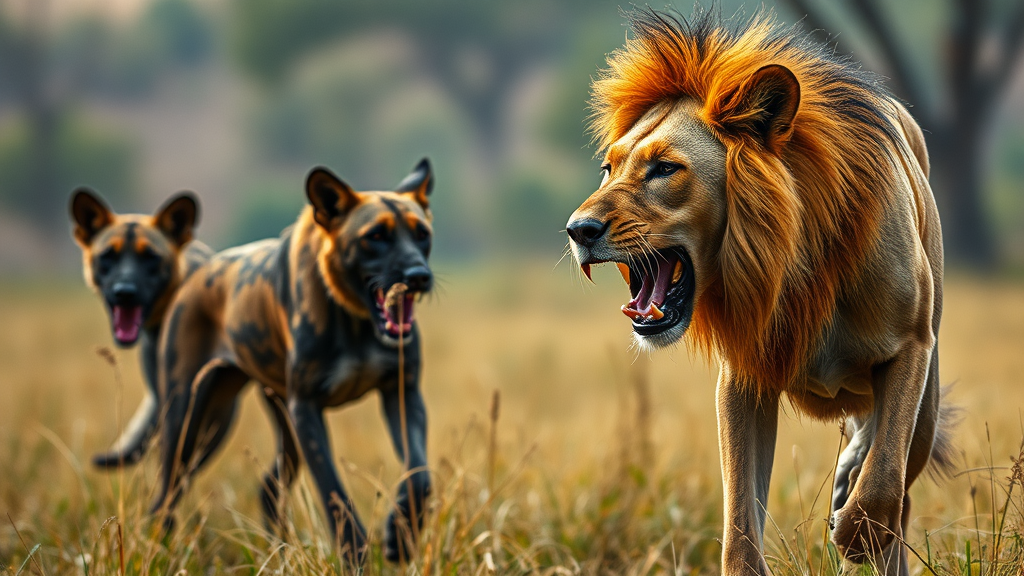
The relationship between lions and African wild dogs is one of the most complex and studied predator interactions in African wildlife research. On the surface, it looks like a simple dominance hierarchy — lions are bigger, stronger, and will kill wild dogs given the opportunity. But the reality playing out daily across the African savannah is far more nuanced. African wild dog packs actively harass lions, steal kills, and in some documented cases, drive lions away from territories the dogs consider their own.
Lions view wild dogs as competitors, not prey. A healthy adult lion has little to fear from a single wild dog. Against a coordinated pack of 15 or more, however, even a lion must calculate the risk. The dogs do not attack to kill lions directly. Their strategy is psychological and logistical — they mob, distract, and exhaust. They nip at flanks, draw attention in multiple directions simultaneously, and create enough chaos that the lion eventually retreats rather than risk injury. An injured lion cannot hunt. For an apex predator, even a minor wound carries life-threatening consequences.
Kleptoparasitism: Who Steals From Whom
Kleptoparasitism — the act of stealing food from another predator — flows in both directions between these species, though not equally. Lions routinely steal kills from wild dog packs. A single lion arriving at a fresh kill can displace an entire pack within minutes. The dogs rarely fight back directly. Instead, they scatter, regroup, and often begin another hunt within the hour. Their high success rate makes losing a kill painful but survivable. Packs in lion-dense areas compensate by hunting more frequently and consuming kills faster before larger predators arrive.
The reverse also happens. Wild dog packs have been filmed and documented successfully harassing lions off kills, particularly when the pack is large and the lion is solitary or young. African wildlife researchers working in Hwange National Park, Zimbabwe, have recorded multiple instances of packs surrounding a lone lioness and forcing her to abandon a carcass entirely. These encounters reveal something important about lion survival strategies — even apex predators make cost-benefit calculations. Defending a single kill against 20 relentlessly mobile, highly coordinated dogs is simply not worth the energy expenditure or injury risk.
Territorial Overlap and Avoidance Behavior
Where lion prides are dense, African wild dog pack densities drop sharply. This pattern appears consistently across research data from multiple ecosystems. Packs actively adjust their home ranges to minimize overlap with lion territories. They travel longer distances between hunting grounds. They shift activity patterns toward times when lions are least active. This behavioral flexibility speaks to the intelligence of wild dogs — they do not challenge lions head-on when avoidance is possible. They adapt their entire lifestyle around the presence of a more powerful competitor.
From ecologists studying predator guild dynamics, this avoidance behavior has measurable cascading effects on prey distribution across the savannah. When wild dogs avoid certain zones, prey animals in those areas face reduced predation pressure from the most efficient hunters in the ecosystem. Lion hunting behavior then shapes not just where dogs hunt but how entire herbivore populations distribute themselves across the landscape. The interaction between these two species is not just a dramatic wildlife spectacle — it actively structures the ecological architecture of the African savannah at every level.
Impact on the Ecosystem: How These Interactions Affect the Broader African Savannah Ecosystem
The rivalry between African wild dogs and lions does far more than produce dramatic wildlife footage. It actively reshapes the African savannah ecosystem at every level. When two of the continent’s most effective predators compete, the effects ripple outward — influencing prey populations, vegetation patterns, and the survival prospects of dozens of other species. Understanding these cascading effects helps explain why protecting both predators matters enormously for the health of the entire ecosystem.
Ecologists call this phenomenon a “trophic cascade.” One predator’s behavior changes another predator’s behavior. That shift changes where prey animals graze. Changed grazing patterns alter vegetation. Altered vegetation affects water retention, soil composition, and the habitat available to birds, insects, and smaller mammals. The push-and-pull between lion prides and wild dog packs functions like an invisible hand constantly redistributing life across the landscape. Remove either species, and the balance collapses in ways that are difficult to reverse.
Prey Distribution and Herbivore Behavior
African wild dogs are extraordinarily efficient hunters. Their success rate sits between 60 and 90 percent — far higher than lions, which succeed roughly 25 to 30 percent of the time. This efficiency means wild dogs exert intense, targeted pressure on specific prey populations wherever they hunt. When lion territories push dog packs out of prime hunting zones, prey animals in those areas experience a sudden drop in predation pressure from the savannah’s most relentless hunters.
Prey animals are not passive participants in this dynamic. Impala, wildebeest, and zebra populations actively respond to predator presence through behavioral changes scientists call the “landscape of fear.” Animals graze differently, move differently, and cluster differently depending on which predators are active nearby. When wild dogs are absent from an area due to lion pressure, herbivores linger longer in open grasslands. Overgrazing follows. Vegetation thins. Soil erodes. The absence of one predator creates a chain of consequences that eventually degrades the habitat for every species in the system.
Research published through National Geographic’s wildlife documentation consistently highlights how the presence of multiple competing predators produces healthier, more diverse ecosystems than single-predator-dominated landscapes. The competition itself generates ecological richness. Neither species can monopolize any zone completely, so prey populations stay mobile and vegetation recovers across broader areas.
Scavenger Communities and Secondary Benefits
Both lions and African wild dogs feed entire communities of scavengers. Vultures, hyenas, jackals, and marabou storks all depend on leftover kills. When wild dogs lose a kill to lions, the carcass often gets consumed more slowly by the larger pride. This slower consumption gives scavengers more access time. When dogs consume kills rapidly — their typical strategy to avoid theft — scavengers must work harder and faster. The competition between these two predators inadvertently regulates how food energy moves through the broader scavenger community.
Hyenas occupy a particularly interesting position in this dynamic. They compete aggressively with both lions and wild dogs. In areas where lions suppress wild dog activity, hyena populations sometimes expand into the vacuum. Hyenas then exert their own pressure on prey populations and on the remaining dog packs. The entire predator guild shifts and rebalances constantly. No single interaction exists in isolation. Every confrontation between a lion and a wild dog pack sends ripples through a network of relationships stretching across the entire savannah.
Conservation Status and Efforts: Current Conservation Efforts for Both Lions and African Wild Dogs
Both lions and African wild dogs face serious conservation pressure. The IUCN Red List classifies African wild dogs as Endangered. Fewer than 6,600 individuals remain in the wild. Their populations are fragmented across sub-Saharan Africa, isolated in patches of suitable habitat surrounded by human settlements, livestock farms, and roads. Lions face their own pressures. The IUCN lists lions as Vulnerable, with populations declining across most of their range due to habitat loss, human-wildlife conflict, and prey depletion.
The WWF actively funds conservation programs targeting both species. Their African wildlife initiatives focus on expanding protected area networks, reducing human-wildlife conflict through community engagement, and supporting anti-poaching operations. Many conservation practitioners find that protecting wild dogs automatically benefits lions and vice versa — both species require large, intact wild areas with healthy prey bases. Saving one effectively means saving the ecosystem both depend on.
Conservationists working in areas like the Okavango Delta and Selous Game Reserve have found that managing the relationship between competing predators requires a whole-ecosystem approach. Simply protecting lions without addressing wild dog survival — or vice versa — produces incomplete results. From wildlife managers at major African reserves, the healthiest ecosystems maintain functioning populations of both species. The competition between them, as intense and dramatic as it appears, is precisely what keeps the African savannah ecosystem dynamic, resilient, and alive.
Community-based conservation programs have shown particular promise. Local communities trained as wildlife monitors track both lion prides and wild dog packs simultaneously. This dual monitoring generates richer data about predator interactions while giving communities direct economic and social investment in the survival of both species. African wildlife conservation, at its most effective, treats the entire predator guild as a single interconnected system worth protecting together.
Myths and Misconceptions: Common Myths About Lions and African Wild Dogs and the Truth Behind Them
Many people assume lions reign completely unchallenged across the African savannah. Popular culture reinforces this idea constantly. Movies, documentaries, and wildlife branding portray lions as invincible apex predators that nothing dares challenge. The reality is far more complex. African wild dogs regularly outcompete lions for food, avoid them through sophisticated behavioral strategies, and thrive in ecosystems where lions also live. The “king of the jungle” narrative, while compelling, leaves out enormous amounts of ecological truth.
One persistent myth claims that lions actively hunt and eliminate wild dog packs to remove competition. Lions do kill wild dogs when opportunities arise, but systematic elimination is not observed behavior. Lions are opportunistic. They steal kills when wild dogs are vulnerable and occasionally kill individual dogs. However, mounting a coordinated campaign against a fast-moving, highly coordinated pack would cost lions more energy than it would gain them. Wild dogs are simply too quick, too agile, and too alert for lions to pursue efficiently. The interaction is competitive, not predatory in any sustained sense.
Wild Dogs Are Not Weak — They Are Specialists
Another common misconception frames African wild dogs as perpetual victims. People see footage of lions chasing dogs off kills and conclude that wild dogs are subordinate, weak, or struggling to survive because of lion pressure. This misreads the situation entirely. Wild dogs have one of the highest hunting success rates of any large predator on the continent — some studies place it above 80 percent. Lions succeed on roughly 25 to 30 percent of hunts by comparison. Wild dogs do not need to win confrontations with lions. They need to eat consistently, and they do exactly that.
Many wildlife observers also believe that wild dogs and lions never coexist peacefully in the same territory. In truth, the two species share vast overlapping ranges across Botswana, Zimbabwe, Tanzania, and South Africa. They have evolved behavioral mechanisms — temporal avoidance, spatial separation, and rapid relocation after kills — that allow coexistence without constant violent conflict. According to National Geographic, African wild dogs demonstrate remarkable behavioral flexibility that allows them to persist even in lion-dense environments.
A third myth suggests that wild dog population decline is primarily caused by lion predation. The primary drivers of African wild dog decline are habitat fragmentation, disease transmission from domestic dogs, vehicle strikes on roads, and direct persecution by humans protecting livestock. Lion pressure is a real ecological stressor, but it is not the dominant threat to the species. Focusing conservation attention on lion-dog conflict misses the larger picture entirely.
Future Outlook for African Wildlife
The future of both lions and African wild dogs depends heavily on decisions made in the next two decades. Habitat loss continues accelerating across sub-Saharan Africa. Human populations are growing. Agricultural expansion pushes deeper into traditional wildlife corridors. Both species need enormous ranges to sustain viable populations. Without connected landscapes, even well-protected core populations become genetically isolated and demographically fragile over time.
Conservation experts increasingly emphasize transboundary wildlife management as the most promising path forward. Single-country protected areas are often too small to sustain the wide-ranging movements of wild dog packs or large lion prides. Regional agreements between Botswana, Zimbabwe, Zambia, and Tanzania — like those governing the Kavango-Zambezi Transfrontier Conservation Area — create the large-scale connected habitats both species require. These agreements represent some of the most ambitious wildlife conservation projects currently active anywhere in the world.
Technology and Data Are Changing Conservation
Advances in tracking technology are transforming how conservationists understand predator interactions. GPS collar data now generates continuous movement records for both lions and wild dog packs. Researchers can map territorial overlaps, identify conflict hotspots, and measure how human infrastructure affects predator behavior at fine spatial scales. This data has already shifted how reserve managers allocate anti-poaching resources and design wildlife corridors between protected areas.
Artificial intelligence tools are beginning to process camera trap images automatically, identifying individual animals by coat patterns and facial features. This accelerates population monitoring dramatically. Conservation teams that once needed months to process thousands of images can now generate population estimates in days. African wildlife conservation is becoming faster, more precise, and more responsive as a result. Both lion and wild dog populations benefit directly from these improvements in monitoring capacity.
Community Engagement Remains the Cornerstone
Expert opinion converges strongly on one point: no conservation strategy succeeds long-term without genuine community support. Local communities living alongside lions and wild dogs bear the real costs of coexistence — livestock losses, crop damage, and occasional human safety risks. Compensation schemes, community conservancies, and wildlife-based tourism revenue sharing give communities direct financial reasons to protect predators rather than persecute them.
Many conservation practitioners find that when communities gain meaningful economic benefit from wildlife, tolerance for predators increases substantially. The WWF and partner organizations have documented measurable reductions in retaliatory killings of both lions and wild dogs in areas with active community benefit programs. African wild dogs and lions are not just ecological actors. They are economic assets for communities that choose to protect them. That shift in perspective, from threat to asset, may prove to be the most powerful conservation tool available.
The African savannah ecosystem faces genuine pressure, but it also demonstrates remarkable resilience. Lions still roar across vast landscapes at dusk. Wild dog packs still sprint across open plains in perfectly coordinated pursuit. The ancient competition between these two extraordinary predators continues, shaping ecosystems and driving evolutionary pressures just as it has for millions of years. Whether that continues depends entirely on the choices humans make about land, wildlife, and coexistence in the decades ahead.
Frequently Asked Questions
What About Communication and Coordination Within the Pack?
African wild dogs use vocalizations and visual signals for coordination. Their democratic decision-making involves ritualized greetings and sneezing to initiate hunts.
What About Pack Survival and Conservation Status?
African wild dogs are endangered due to habitat loss and disease. Packs require a minimum of five to six adults to function effectively and survive.